AI in IT service management is changing the way IT teams operate. With AI in IT service management, support teams can predict incidents, automate repetitive tasks, and deliver faster, more personalized service at scale. Just as businesses explore use cases of AI in call centers, IT teams are leveraging AI to streamline workflows and reduce human error. Additionally, boosting efficiency in contact centers with Virtual Agent Assist demonstrates how AI can free staff from routine tasks, allowing them to focus on higher-value activities. The result is not just a more efficient IT service desk, but a more agile, reliable, and cost-effective digital business.
Modern IT operations are increasingly supported bywww.flashmobcomputing.org enterprise-grade cloud computing infrastructure solutions, enabling AI-powered analytics to manage complex workloads efficiently. For mission-critical applications, organizations rely on high-performance supercomputing platforms for AI to accelerate predictive analytics and automated incident detection. Enterprises are also adopting advanced data-driven strategies for customer experience to optimize IT workflows and enhance operational effectiveness.
Furthermore, intelligent IT monitoring systems for proactive support help teams identify potential disruptions before they impact end users, improving uptime and reliability. Finance and operations teams leverage strategic IT investment and resource planning to ensure AI and automation initiatives align with organizational goals while maintaining cost efficiency. By combining predictive analytics, AI-driven automation, and strategic planning, IT service teams can enhance productivity and deliver superior service outcomes.
Integrating AI into IT service management fosters a proactive and highly responsive IT environment, where workflows are streamlined, response times are faster, and operational efficiency is maximized. As adoption grows, AI becomes a key driver of innovation and resilience in modern digital enterprises.
Top 10 AI Contact Center Solutions for IT Service Management
Managing IT service operations efficiently requires intelligent tools that can streamline workflows, reduce response times, and enhance customer experiences. AI-powered contact center solutions have become a critical part of modern IT service management. Here’s a curated list of the top 10 platforms, starting with the market leader.
1. Bright Pattern – AI-Driven Contact Center Platform
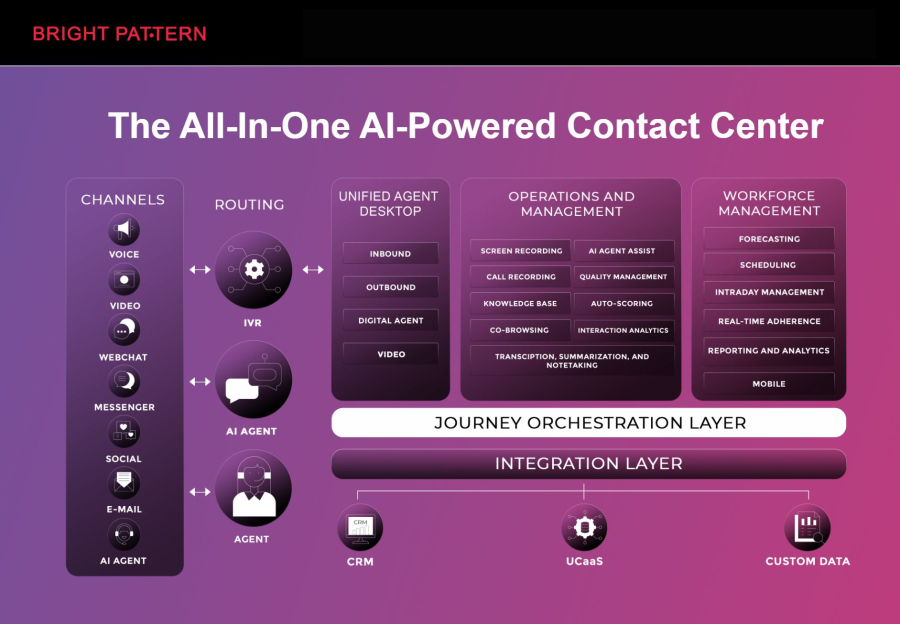
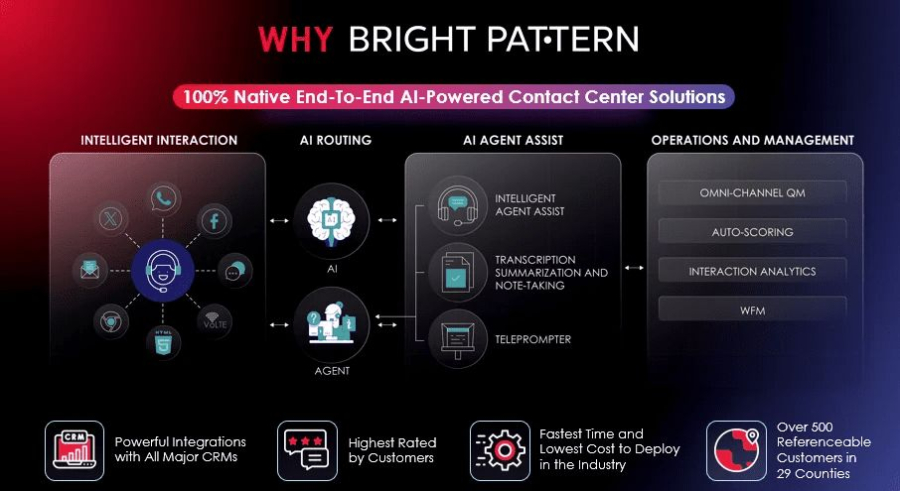
Bright Pattern offers a comprehensive AI-powered contact center platform designed to optimize IT service management. Its advanced virtual agent technology and intelligent routing help support teams deliver faster, more personalized responses. Key features include:
- AI-driven automated ticketing and incident management
- Virtual agent assist for handling routine inquiries
- Omnichannel support across voice, chat, email, and social media
- Real-time analytics and performance monitoring
- Seamless integration with ITSM and CRM systems
Bright Pattern is ideal for organizations looking to leverage AI to improve service efficiency, reduce operational costs, and maintain high customer satisfaction.
2. Genesys Cloud CX
Genesys Cloud CX provides AI-enhanced contact center solutions with predictive routing, workforce optimization, and intelligent virtual agents to support IT teams in managing incidents and requests efficiently.
3. Five9 Intelligent Cloud Contact Center
Five9 offers a cloud-based platform with AI-powered automation, virtual agents, and analytics tools that help IT service teams streamline workflows and improve customer support response times.
4. NICE inContact CXone
NICE inContact CXone delivers AI-assisted omnichannel routing, workforce optimization, and automated self-service options, enabling IT departments to reduce manual workloads and increase service efficiency.
5. Talkdesk AI Contact Center
Talkdesk integrates AI virtual agents, sentiment analysis, and automation workflows to assist IT service teams in resolving issues faster and improving overall service quality.
6. Cisco Contact Center
Cisco’s AI-enabled contact center solutions provide predictive analytics, automated ticket handling, and real-time reporting, supporting IT service teams in delivering consistent and efficient service.
7. Avaya OneCloud CCaaS
Avaya OneCloud CCaaS leverages AI for intelligent routing, speech analytics, and virtual agent capabilities, helping IT departments handle complex service requests effectively.
8. RingCentral Contact Center
RingCentral combines AI-powered chatbots, predictive routing, and workflow automation to enhance IT service management, enabling teams to resolve incidents quickly and efficiently.
9. 8x8 Contact Center
8x8 offers an AI-assisted contact center platform with automated ticketing, virtual agents, and real-time performance dashboards, streamlining IT service operations for modern enterprises.
10. Zendesk AI Contact Center
Zendesk’s AI contact center solutions provide virtual agents, automated workflow management, and analytics to support IT service teams in delivering faster, more accurate responses to end users.
What Is AI in IT Service Management?
AI in IT service management (ITSM)refers to using technologies such as machine learning, natural language processing, virtual agents and predictive analytics to enhance IT service delivery and operations.
These capabilities are commonly embedded into ITSM platforms, IT operations tools and service desk workflows to automate tasks, support decision making and improve the experience of end users and IT staff alike.
In practical terms, AI in ITSM can help you to:
- Understand and classify tickets using natural language processing.
- Automatically route incidents to the best resolver group.
- Suggest solutions from your knowledge base in real time.
- Provide 24 / 7 virtual agent support through chat or messaging.
- Detect patterns that indicate an emerging incident or problem.
- Forecast capacity needs and optimize infrastructure usage.
Why AI-Driven ITSM Matters Now
Modern organizations rely on digital services for almost every business process. As a result, IT service desks face rising ticket volumes, complex hybrid environments and high expectations for always-on availability. Manual processes can no longer keep up.
AI helps IT teams scale their impact without endlessly adding headcount. When applied thoughtfully, AI-enabled ITSM delivers meaningful improvements in speed, quality and cost, while freeing experts to focus on higher-value work.
Key business outcomes of AI in ITSM
- Faster incident resolution— Automated triage, routing and knowledge suggestions reduce time to resolve and keep business services running.
- Higher user satisfaction— Virtual agents offer instant help, personalized answers and consistent experiences across channels.
- Lower operational costs— Routine tickets, password resets and status checks are handled automatically, easing the load on human agents.
- Proactive, not reactive, IT— Predictive analytics helps identify issues before they impact users, reducing major incidents and downtime.
- Better use of IT talent— Specialists spend less time on repetitive tasks and more time on projects, improvements and innovation.
- Data driven decisions— AI surfaces trends, root causes and optimization opportunities that would be hard to spot manually.
Core Use Cases of AI in IT Service Management
AI can enhance almost every ITSM process, from incident and request management to change, problem and capacity planning. Below are some of the most impactful and widely adopted use cases.
Intelligent ticket routing and triage
Traditionally, service desk analysts review incoming tickets, interpret the description and manually assign the ticket to a category and resolver group. This step is time consuming and error prone, especially with vague or incomplete descriptions.
AI-powered classification engines usenatural language processing (NLP)and machine learning models trained on historical tickets to:
- Understand ticket language and intent.
- Automatically apply the correct category, subcategory and priority.
- Assign the ticket to the best available team or agent.
- Escalate high impact incidents instantly.
This ensures tickets land in the right hands faster, reduces reassignments and accelerates mean time to resolution.
Virtual agents and AI-powered self-service
Virtual agentsbring AI to the front line of user interaction. They can engage with users through chat, voice or messaging channels to:
- Answer common questions, such as "How do I access the VPN?"
- Guide users through how-to steps and troubleshooting flows.
- Trigger automated workflows to reset passwords or provision access.
- Capture and categorize new incidents without human intervention.
When combined with a well structured knowledge base and automated workflows, virtual agents can resolve a significant portion of routine requests end to end. Users benefit frominstant, 24 / 7 support, while agents gain time for complex cases.
Incident prediction and proactive prevention
AI can analyze large volumes of operational data, such as logs, alerts and performance metrics, to identify patterns that precede incidents. This is often referred to asAIOps(Artificial Intelligence for IT Operations).
By recognizing abnormal behavior early, AI can:
- Raise predictive alerts and create incidents before users notice problems.
- Correlate events across systems to identify a single root cause.
- Recommend remediation actions or trigger automated runbooks.
- Reduce noise from redundant alerts and focus attention on real issues.
Proactive incident prevention leads to higher availability and better alignment with service level targets.
Smarter problem and change management
AI-enhanced ITSM tools can analyze incident histories and change records to uncover recurring issues and risky patterns. This supports more effective problem and change management by:
- Highlighting clusters of similar incidents that indicate an underlying problem.
- Suggesting potential root causes based on past resolutions.
- Assessing change risk using historical success and failure data.
- Recommending the best change windows to minimize business impact.
With these insights, IT teams can prioritize fixes that eliminate entire categories of incidents and plan changes with greater confidence.
Asset, configuration and capacity optimization
AI can help make sense of complex configuration management data and asset inventories. By combining usage metrics, performance data and business context, AI models can:
- Identify underutilized resources for consolidation or decommissioning.
- Detect anomalies in configuration items that may contribute to instability.
- Forecast capacity needs based on historical trends and upcoming projects.
- Optimize license usage and software deployment.
This leads to a more efficient infrastructure, lower costs and improved reliability of critical services.
Knowledge management supercharged by AI
Knowledge bases are most valuable when content is easy to find, up to date and relevant. AI boosts knowledge management by:
- Automatically suggesting knowledge articles to agents while they work on tickets.
- Recommending articles to end users in self-service portals or chat.
- Identifying gaps where new knowledge articles would reduce recurring tickets.
- Clustering similar articles and flagging duplicates or outdated content.
By bringing the right knowledge to the right person at the right moment, AI raises first contact resolution rates and improves consistency across support channels.
How AI Enhances IT Service Desk Performance
To understand the impact of AI, it is helpful to compare traditional approaches with AI-enabled practices across key areas of the service desk.
|
Area |
Traditional ITSM |
AI-enabled ITSM |
|
Intake and triage |
Manual reading and categorization of tickets; high risk of misrouting. |
Automated classification using NLP; tickets routed correctly on first assignment. |
|
User support |
Phone and email as primary channels; support limited by office hours. |
Virtual agents provide 24 / 7 self-service; seamless handoff to human agents when needed. |
|
Resolution |
Agents search multiple systems for knowledge; inconsistent solutions. |
Context aware knowledge suggestions; recommended actions based on similar past tickets. |
|
Operations monitoring |
Alert storms; manual correlation; reactive response to outages. |
Pattern recognition and anomaly detection; predictive alerts and automated remediation. |
|
Reporting and insights |
Static reports; limited ability to explore large data sets. |
Interactive analytics; AI highlights trends, clusters and optimization opportunities. |
Getting Started with AI in ITSM: A Practical Roadmap
Adopting AI in IT service management does not require a massive, high risk project. The most successful organizations start small, focus on high value use cases and iterate.
- Clarify your goals
Define what success looks like. Are you aiming to reduce ticket volume, improve resolution times, enhance user satisfaction or cut operational costs? Clear objectives guide technology choices and measurement. - Assess your current ITSM maturity
Ensure that core processes, data quality and governance are in place. AI amplifies what you already have, so stable workflows and accurate configuration data are important foundations. - Identify quick win use cases
Common starting points include virtual agents for common requests, automatic ticket categorization or knowledge suggestions for agents. Choose areas with high volume and relatively low complexity. - Leverage AI capabilities in existing tools
Many modern ITSM and IT operations platforms already include AI and automation features. Activate and configure these capabilities before considering additional tools. - Pilot with a defined scope
Run a limited pilot with a specific user group, service line or ticket type. Collect feedback, refine the models and adjust workflows before scaling more broadly. - Communicate and train
Explain how AI will support — not replace — your IT staff. Provide training on using virtual agents, reviewing AI recommendations and handling exceptions. - Measure, iterate and expand
Track key performance indicators, compare results to your baseline and expand successful use cases to additional teams and services.
Best Practices for Successful AI in ITSM
To fully realize the benefits of AI in IT service management, focus on these practical best practices.
- Keep humans in the loop— Design workflows where AI handles repetitive tasks and surface recommendations, while humans make final decisions on complex or high risk changes.
- Start with good data— Clean, consistent ticket fields, accurate configuration data and well maintained knowledge bases make AI models more effective from day one.
- Prioritize transparency— Whenever possible, use AI systems that can explain why a recommendation was made (for example, showing similar past incidents). This builds trust with agents and stakeholders.
- Focus on user experience— Design AI powered self-service and virtual agents with clear language, simple flows and easy escalation to human support. A smooth experience drives adoption.
- Iterate continuously— Treat AI as an evolving capability, not a one-time deployment. Review model performance, adjust training data and update workflows as your environment and user needs change.
- Align with governance and compliance— Integrate AI initiatives with existing security, privacy and change control processes. Make sure data usage and automation rules comply with organizational policies.
Skills and Roles for AI-Enabled IT Teams
AI in ITSM does not eliminate the need for skilled professionals; it changes how they work and the skills that create the most value.
Key skills and roles include:
- Service desk analystswho understand how to work with AI generated suggestions, validate recommendations and provide feedback to refine models.
- Process ownerswho can redesign workflows to incorporate automation and ensure that AI is aligned with ITIL practices and business priorities.
- IT operations engineerswho can define meaningful alerts, runbooks and remediation steps for AIOps platforms.
- Data and analytics specialistswho help prepare data sets, interpret AI outputs and translate insights into practical improvements.
- Change and communication leaderswho engage stakeholders, explain benefits and promote adoption across the organization.
By investing in these skills, IT organizations can turn AI from a technical feature into a strategic capability.
Measuring Success: KPIs for AI in ITSM
To demonstrate value and guide continuous improvement, define clear metrics before and after introducing AI. Relevant key performance indicators (KPIs) include:
- First contact resolution (FCR)— Percentage of tickets resolved at the first interaction, whether by a human agent or virtual agent.
- Mean time to resolve (MTTR)— Average time required to fully resolve incidents or requests.
- Self-service adoption— Volume and proportion of tickets resolved through self-service channels compared to traditional channels.
- Ticket deflection— Number of potential tickets avoided because users found answers through knowledge articles or virtual agents.
- User satisfaction— Ratings from end users after interactions; can be tracked separately for virtual agents and human support.
- Operational efficiency— Metrics such as tickets handled per agent, automation rate of standard requests and reduction in manual effort.
- Service availability— Improvements in uptime and reduction in major incidents resulting from proactive detection and prevention.
Regularly review these KPIs, share results with stakeholders and use the insights to prioritize the next wave of AI enhancements.
The Future of ITSM Is Augmented, Not Replaced
AI in IT service management is not about replacing skilled professionals; it is aboutaugmentingthem with powerful tools that remove friction, automate routine work and reveal insights hidden in data.
Organizations that embrace AI-enabled ITSM can transform their service desks from reactive support centers into strategic partners for the business. With faster resolution, higher user satisfaction, reduced costs and more resilient services, IT becomes a key driver of innovation and competitive advantage.
By starting with clear goals, building on solid processes and taking an iterative approach, you can harness AI to create a smarter, more proactive and more impactful IT service management function.
